I bibliotecari sono a disposizione dell'utenza per ricerche bibliografiche sul catalogo
e per assistenza nell'uso delle risorse della Biblioteca digitale.
Il personale fornisce inoltre informazioni su tutti i servizi bibliotecari.

lunedì 20 marzo 2017

The European Convention on Human Rights
A Commentary
William A. Schabas

The European Convention on Human Rights: A Commentary is the first complete article-by-article commentary on the ECHR and its Protocols in English. This book provides an entry point for every part of the Convention: the substance of the rights, the workings of the Court, and the enforcement of its judgments. A separate chapter is devoted to each distinct provision or article of the Convention as well as to Protocols 1, 4, 6, 7, 12, 13, and 16, which have not been incorporated in the Convention itself and remain applicable to present law.
Each chapter contains: a short introduction placing the provision within the context of international human rights law more generally; a review of the drafting history or preparatory work of the provision; a discussion of the interpretation of the text and the legal issues, with references to the case law of the European Court of Human Rights and the European Commission on Human Rights; and a selective bibliography on the provision.

Through a thorough review of the ECHR this commentary is both exhaustive and concise. It is an accessible resource that is ideal for lawyers, students, journalists, and others with an interest in the world's most successful human rights regime.
Natural Experiments in the Social Sciences
A Design-Based Approach
Thad Dunning


This unique book is the first comprehensive guide to the discovery, analysis, and evaluation of natural experiments - an increasingly popular methodology in the social sciences. Thad Dunning provides an introduction to key issues in causal inference, including model specification, and emphasizes the importance of strong research design over complex statistical analysis. Surveying many examples of standard natural experiments, regression-discontinuity designs, and instrumental-variables designs, Dunning highlights both the strengths and potential weaknesses of these methods, aiding researchers in better harnessing the promise of natural experiments while avoiding the pitfalls. Dunning also demonstrates the contribution of qualitative methods to natural experiments and proposes new ways to integrate qualitative and quantitative techniques. Chapters complete with exercises and appendices covering specialized topics such as cluster-randomized natural experiments, make this an ideal teaching tool as well as a valuable book for professional researchers.
Criminalization
The Political Morality of the Criminal Law
Edited by R A Duff, Lindsay Farmer, S E Marshall, Massimo Renzo, and Victor Tadros


The Criminalization series arose from an interdisciplinary investigation into criminalization, focussing on the principles that might guide decisions about what kinds of conduct should be criminalized, and the forms that criminalization should take. Developing a normative theory of criminalization, the series tackles the key questions at the heart of the issue: what principles and goals should guide legislators in deciding what to criminalize? How should criminal wrongs be classified and differentiated? How should law enforcement officials apply the law's specifications of offences?
The fourth book in the series examines the political morality of the criminal law, exploring general principles and theories of criminalization. Chapters provide accounts of the criminal law in the light of ambitious theories about moral and political philosophy - republicanism and contractarianism, or reflect upon on the success of important theories of criminalization by viewing them in a novel light. Ideas that are fundamental to any complete theory of the criminal law - liberty, harm, and the effect on victims - are investigated in depth. Sociological investigation of the criminal law grounds a critical investigation into the principles of criminalization, both as a legislative matter, and with respect to criminalization practices, in contemporary and historical contexts.

The volume broadens our conceptions of the theory of criminalization, and clarifies the role of the series in the development of this theory. It is essential reading for all interested in legal, political, and social theories of criminalization.
Ashworth's Principles of Criminal Law
Jeremy Horder


Ashworth's Principles of Criminal Law, now in its eight edition, takes a distinctly different approach to the study of criminal law, whilst still covering all of the vital topics found on criminal law courses. Uniquely theoretical, it seeks to elucidate the underlying principles and theoretical foundations of the criminal law, and aims to critically engage readers by contextualizing and analysing the law.
This is essential reading for students seeking a sophisticated and critically engaging exploration of the subject.

The text is accompanied by an Online Resource Centre housing a full bibliography as well as a selection of useful web links.
Making the Modern Criminal Law
Criminalization and Civil Order
Lindsay Farmer

The Criminalization series arose from an interdisciplinary investigation into criminalization, focussing on the principles that might guide decisions about what kinds of conduct should be criminalized, and the forms that criminalization should take. Developing a normative theory of criminalization, the series tackles the key questions at the heart of the issue: what principles and goals should guide legislators in deciding what to criminalize? How should criminal wrongs be classified and differentiated? How should law enforcement officials apply the law's specifications of offences?
This, the fifth book in the series, offers a historical and conceptual account of the development of the modern criminal law in England and as it has spread to common law jurisdictions around the world. The book offers a historical perspective on the development of theories of criminalization. It shows how the emergence of theories of criminalization is inextricably linked to modern understandings of the criminal law as a conceptually distinct body of rules, and how this in turn has been shaped by the changing functions of criminal law as an instrument of government in the modern state.

The book is structured in two main parts. The first traces the development of the modern law as a distinct, and conceptually distinct body of rules, looking in particular at ideas of jurisdiction, codification and responsibility. The second part then engages in detailed analysis of specific areas of criminal law, focusing on patterns of criminalization in relation to property, the person, and sexual conduct. been expected to perform at different points in history.
In Search of Criminal Responsibility
Ideas, Interests, and Institutions
Nicola Lacey

What makes someone responsible for a crime and therefore liable to punishment under the criminal law? Modern lawyers will quickly and easily point to the criminal law's requirement of concurrent actus reus and mens rea, doctrines of the criminal law which ensure that someone will only be found criminally responsible if they have committed criminal conduct while possessing capacities of understanding, awareness, and self-control at the time of offense. Any notion of criminal responsibility based on the character of the offender, meaning an implication of criminality based on reputation or the assumed disposition of the person, would seem to today's criminal lawyer a relic of the 18th Century. In this volume, Nicola Lacey demonstrates that the practice of character-based patterns of attribution was not laid to rest in 18th Century criminal law, but is alive and well in contemporary English criminal responsibility-attribution.
Building upon the analysis of criminal responsibility in her previous book, Women, Crime, and Character, Lacey investigates the changing nature of criminal responsibility in English law from the mid-18th Century to the early 21st Century. Through a combined philosophical, historical, and socio-legal approach, this volume evidences how the theory behind criminal responsibility has shifted over time. The character and outcome responsibility which dominated criminal law in the 18th Century diminished in ideological importance in the following two centuries, when the idea of responsibility as founded in capacity was gradually established as the core of criminal law. Lacey traces the historical trajectory of responsibility into the 21st Century, arguing that ideas of character responsibility and the discourse of responsibility as founded in risk are enjoying a renaissance in the modern criminal law. These ideas of criminal responsibility are explored through an examination of the institutions through which they are produced, interpreted and executed; the interests which have shaped both doctrines and institutions; and the substantive social functions which criminal law and punishment have 

giovedì 2 marzo 2017

International Investment Law
Bungenberg/Griebel/Hobe/Reinisch

International investment law is a subject of growing importance and complexity. Anyone interested in international investment law will appreciate the comprehensive, thoughtful and detailed exploration of this area which this distinguished group of German scholars have provided.
Editore: Hart Publishing
Genere: Law  International

ISBN-13: 9781849463638


The Law and Politics of International Regime Conflict
Dirk Pulkowski

The international order is constituted by a plurality of international regimes - institutionalized arrangements in different issue areas that possess their own norms and procedures. The present book examines how conflict among regimes may arise and probes the role that international law can play in managing such conflict. Throughout the book, the example of trade in cultural products is used to illustrate the evolution of regime conflict and the potential for its management. Conflicts between the goals of 'free trade' and 'cultural diversity' have notably surfaced within the World Trade Organization (WTO) and the United Nations Educational, Scientific and Cultural Organization (UNESCO). As a result, there is a potential for conflict among WTO law, the UNESCO's Convention on the Protection and Promotion of the Diversity of Cultural Expressions, and human rights.

The book posits that three dimensions are characteristic for regime conflict: First, regime conflict is a function of conflict among different social goals or values. Second, such goal conflicts are institutionalized through the interaction of a variety of political actors struggling for influence, often in intergovernmental organizations. Third, regime conflict may manifest itself in conflicts of legal rules. If a state acts in conformity with the rules of one regime, its conduct may trigger a violation of the rules of another regime.


The author argues that, while international law cannot be construed as a fully integrated and unified system, it does provide a common language for different regimes to engage with each other. The shared discourse rules of international law enable a degree of coordination of the policies of different regimes, notably through techniques of interpretation and legal priority rules. International law contributes to the management of regime conflict by providing commonly accepted reasons for choosing among competing policy goals.
Complicity in International Law
di Miles Jackson (Autore)

This book examines how international law prohibits state and individual complicity. Complicity is a derivative form of responsibility that links an accomplice to the wrongdoing of a principal actor. Whenever a legal system prohibits complicity, it must address certain questions as to the content and structure of the rules. To understand how international law answers these questions, this book proposes an analytical framework in which complicity rules may be assessed and defends a normative claim as to how they should be structured.
Anchored by this framework and normative claim, this book shows that international criminal law regulates individual complicity in a comprehensive way, using the doctrines of instigation and aiding and abetting to inculpate complicit participants in international crimes. By contrast, international law's regulation of state complicity was historically marked by an absence of complicity rules. This is changing. In respect of state complicity in the wrongdoing of another state, international law now imposes both specific and general complicity obligations, the latter prohibiting states from aiding or assisting another state in the commission of any internationally wrongful act. In respect of the ways that states participate in harms caused by non-state actors, the traditional normative structure of international law, which imposed obligations only on states, foreclosed the possibility of prohibiting the state's participation as a form of complicity. As that traditional normative structure has evolved, so the possibility of holding states responsible for complicity in the wrongdoing of non-state actors has emerged.

More and more, both the wrongs that international actors commit, and the wrongs they help or encourage others to commit, matter.
The UN Convention on the Elimination of All Forms of Discrimination Against Women: A Commentary
di Marsha A. Freeman (a cura di),
Christine Chinkin (a cura di),
Beate Rudolf (a cura di)

This volume is the first comprehensive commentary on the Convention on the Elimination of All Forms of Discrimination against Women and its Optional Protocol. The Convention is a key international human rights instrument and the only one exclusively addressed to women. It has been described as the United Nations' 'landmark treaty in the struggle for women's rights'.

The Commentary describes the application of the Convention through the work of its monitoring body, the Committee on the Elimination of Discrimination against Women. It comprises detailed analyses of the Preamble and each article of the Convention and of the Optional Protocol. It also includes a separate chapter on the cross-cutting substantive issue of violence against women. The sources relied on are the treaty language and the general recommendations, concluding observations and case law under the Optional Protocol, through which the Committee has interpreted and applied the Convention. Each chapter is self-contained but the Commentary is conceived of as an integral whole. The book also includes an introduction which provides an overview of the Convention and its embedding in the international law of human rights.
 
Diplomatic Law:
Commentary on the Vienna Convention on Diplomatic Relations
di Professor Eileen Denza (Autore)


Diplomatic Law was first published in 1976. Written with the benefit of the author's deep and practical understanding of the subject as a Legal Counsellor in the Foreign and Commonwealth Office, it has become widely regarded as the leading work in the field. Denza places each provision of the Convention in its historical context; provides commentary on the application of the Convention by the UK, the US, and other States; and thoroughly examines topical problems in the field including the abuse of diplomatic immunity and terrorist violence. This fully updated new edition also highlights important new trends in the application of the Convention regime. It explores the interaction between State and diplomatic immunity (as shown in the Pinochet case), examines methods of establishing and conducting diplomatic relations under conditions of physical danger, and looks at increased evidence of disregard for the rules of secrecy in diplomatic communications. Denza also explores and the greater latitude for diplomats to 'interfere' in the internal affairs of the receiving State in the interest of protecting human rights and evaluates the impact of adoption of the UN Convention on Jurisdictional Immunities of States and their Property.
The 1949 Geneva Conventions: A Commentary
di Andrew Clapham  (a cura di),
Paola Gaeta (a cura di),
Marco Sassòli (a cura di)

The four Geneva Conventions, adopted in 1949, remain the fundamental basis of contemporary international humanitarian law. They protect the wounded and sick on the battlefield, those wounded, sick or shipwrecked at sea, prisoners of war, and civilians in time of war. However, since they were adopted warfare has changed considerably. In this groundbreaking commentary over sixty international law experts investigate the application of the Geneva Conventions and explain
how they should be interpreted today. It places the Conventions in the light of the developing obligations imposed by international law on states, armed groups, and individuals, most notably through international human rights law and international criminal law.
The context in which the Conventions are to be applied and interpreted has changed considerably since they were first written. The borderline between international and non-international armed conflicts is not as clear-cut as was once thought, and is complicated further by the use of armed force mandated by the United Nations and the complex mixed and transnational nature of certain non-international armed conflicts. The influence of other developing branches of international law, such as human
rights law and refugee law has been considerable. The development of international criminal law has breathed new life into multiple provisions of the Geneva Conventions. This commentary adopts a thematic approach to provide detailed analysis of each key issue dealt with by the Conventions, taking

into account both judicial decisions and state practice. Cross-cutting chapters on issues such as transnational conflicts and the geographical scope of the Conventions also give readers a full understanding of the meaning of the Geneva Conventions in their contemporary context. Prepared under the auspices of the Geneva Academy of International Humanitarian Law and Human Rights, this commentary on four of the most important treaties in international law is unmissable for anyone working in or studying situations of armed conflicts.
The Sources of International Law
di Hugh Thirlway (Autore)

In recent years States have made more and more extensive use of the International Court of Justice for the judicial settlement of disputes. Despite being declared by the Courts Statute to have no binding force for States other than the parties to the case, its decisions have come to constitute a body of jurisprudence that is frequently invoked in other disputes, in international negotiation, and in academic writing. This jurisprudence, covering a wide range of
aspects of international law, is the subject of considerable ongoing academic examination; it needs however to be seen against the background, and in the light, of the Courts structure, jurisdiction and operation, and the principles applied in these domains. The purpose of this book is thus to provide an

accessible and comprehensive study of this aspect of the Court, and in particular of its procedure, written by a scholar who has had unique opportunities of close observation of the Court in action. This distillation of direct experience and expertise makes it essential reading for all those who study, teach or practise international law.
 
International Law
di Malcolm Evans (a cura di)

Evans' International Law provides wide-ranging analysis of all the key issues and themes in public international law and brings together an outstanding collection of interesting and diverse writings from the leading scholars in the field.
The fourth edition succeeds both in explaining the principles of international law and exposing the debates and challenges that underlie it. Now fully revised and updated, it continues to provide an authoritative and stimulating overview of this increasingly important subject; revealing international law in its full diversity.

International Law is also accompanied by an Online Resource Centre, featuring the personal views and recollections of eminent international law practitioners.
The International Law on Foreign Investment
di M. Sornarajah (Autore)


Following the Trans-Pacific Partnership (TPP) and Transatlantic Trade and Investment Partnership (TTIP), the demonstrations against investor-state arbitration and the wide discussion during the 2016 US presidential election, the climate surrounding foreign investment law is one of controversy and change, and with implications for human rights and environmental protection, foreign investment law has gained widespread public attention and visibility. Addressing the pressing need to examine foreign investment law in the context of public international law, the role of the multinational corporation in foreign investment and issues of liability for environmental and other damage, this new edition analyses contractual and treaty-based methods of investment protection and examines the effectiveness of bilateral and regional investment treaties. By offering thought-provoking analysis of the law in historical, political and economic contexts, this fully updated edition of Sornarajah's classic text captures leading trends and charts the possible course of future developments. Suitable for postgraduate and undergraduate students, The International Law on Foreign Investment is essential reading for anyone specialising in the law of foreign investments.

mercoledì 1 marzo 2017

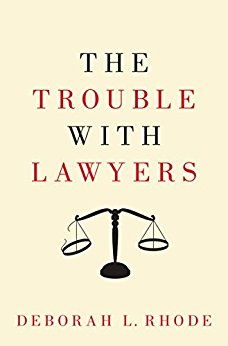
The Trouble with Lawyers
di Deborah L. Rhode (Autore)

By any measure, the law as a profession is in serious trouble. Americans' trust in lawyers is at a low, and many members of the profession wish they had chosen a different path. Law schools, with their endlessly rising tuitions, are churning out too many graduates for the jobs available. Yet despite the glut of lawyers, the United States ranks 67th (tied with Uganda) of 97 countries in access to justice and affordability of legal services. The upper echelons of the legal establishment remain heavily white and male. Most problematic of all, the professional organizations that could help remedy these concerns instead jealously protect their prerogatives, stifling necessary innovation and failing to hold practitioners accountable.
Deborah Rhode's The Trouble with Lawyers is a comprehensive account of the challenges facing the American bar. She examines how the problems have affected (and originated within) law schools, firms, and governance institutions like bar associations; the impact on the justice system and access to lawyers for the poor; and the profession's underlying difficulties with diversity. She uncovers the structural problems, from the tyranny of law school rankings and billable hours to the lack of accountability and innovation built into legal governance-all of which do a disservice to lawyers, their clients, and the public.

The Trouble with Lawyers is a clear call to fix a profession that has gone badly off the rails, and a source of innovative responses
Jus Post Bellum and Transitional Justice
di Larry May (a cura di)
Elizabeth Edenberg (a cura di)


This collection of essays brings together jus post bellum and transitional justice theorists to explore the legal and moral questions that arise at the end of war and in the transition to less oppressive regimes. Transitional justice and jus post bellum share in common many concepts that will be explored in this volume. In both transitional justice and jus post bellum, retribution is crucial. In some contexts criminal trials will need to be held, and in others truth commissions and other hybrid trials will be considered more appropriate means for securing some form of retribution. But there is a difference between how jus post bellum is conceptualized, where the key is securing peace, and transitional justice, where the key is often greater democratization. This collection of essays highlights both the overlap and the differences between these emerging bodies of scholarship and incipient law.
Morality, Jus Post Bellum, and International Law
di Larry May (a cura di), Andrew Forcehimes (a cura di)


This collection of essays brings together some of the leading legal, political and moral theorists to discuss the normative issues that arise when war concludes and when a society strives to regain peace. In the transition from war, mass atrocity or a repressive regime, how should we regard the idea of democracy and human rights? Should regimes be toppled unless they are democratic or is it sufficient that these regimes are less repressive than before? Are there moral reasons for thinking that soldiers should be relieved of responsibility so as to advance the goal of peace building? And how should we regard the often conflicting goals of telling the truth about what occurred in the past and allowing individuals to have their day in court? These questions and more are analyzed in detail. It also explores whether jus post bellum itself should be a distinct field of inquiry.

The Future of International Law: 
Global Government
di Joel P. Trachtman  (Autore)


The world is changing rapidly and there are increasing calls for international and legal responses. Social changes in areas such as globalization, development, demography, democratization and technology are growing in importance for both citizens and states. Over time this will be reflected in international law and organizational structures, which will have more prominence in governmental functions. In this sense the future of international law is global government. This book draws together the theoretical and practical aspects of international cooperation needs and legal responses in critical areas of global concern and predicts that a more extensive, powerful and varied international legal system will be needed to cope with future opportunities and challenges.
Theoretical Boundaries of Armed Conflict and Human Rights
di Jens David Ohlin (a cura di)


In the last two decades, human rights law has played an expanding role in the legal regulation of wartime conduct. In the process, human rights law and international humanitarian law have developed a complicated sibling relationship. For some, this relationship is viewed as a mutually reinforcing effort between like-minded regimes designed to civilize human behavior. For others, the relationship is a more complicated sibling rivalry. In this book, an unparalleled collection of legal theorists examine the relationship between these two bodies of law. Each chapter skilfully maps the possibilities of harmonization while, at the same time, raising cautionary flags about the limits of that project. The authors not only chart the existing state of the law, but also debate the normative implications of the continuing influence of human rights norms on current practices including torture, targeted killings, the conduct of non-international armed conflicts, and post-war state building.