White weddings:
romancing heterosexuality in popular culture
Chrys Ingraham
This is a groundbreaking study of our culture's obsession with weddings. By examining popular films, commercials, magazines, advertising, television sitcoms and even children's toys, this book shows the pervasive influence of weddings in our culture and the important role they play in maintaining the romance of heterosexuality, the myth of white supremacy and the insatiable appetite of consumer capitalism. It examines how the economics and marketing of weddings have replaced the religious and moral view of marriage. This second edition includes many new and updated features including: full coverage of the wedding industrial complex; gay marriage and its relationship to white weddings and heterosexuality and demographics shifts as to who is marrying whom and why, nationally and internationally.
venerdì 25 novembre 2011
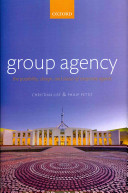
Group agency:
the possibility, design,
and status of corporate agents
Christian List, Philip Pettit
Are companies, churches, and states genuine agents? Or are they just collections of individuals that give a misleading impression of unity? This question is important, since the answer dictates how we should explain the behaviour of these entities and whether we should treat them as responsible and accountable on the model of individual agents. Group Agency offers a new approach to that question and is relevant, therefore, to a range of fields from philosophy to law, politics, and the social sciences. Christian List and Philip Pettit argue that there really are group or corporate agents, over and above the individual agents who compose them, and that a proper approach to the social sciences, law, morality, and politics must take account of this fact. Unlike some earlier defences of group agency, their account is entirely unmysterious in character and, despite not being technically difficult, is grounded in cutting-edge work in social choice theory, economics, and philosophy.
The constitutionalization of international law
Jan Klabbers, Anne Peters, Geir Ulfstein
The book examines one of the most debated issues in current international law: to what extent the international legal system has constitutional features comparable to what we find in national law. This question has become increasingly relevant in a time of globalization, where new international institutions and courts are established to address international issues. Constitutionalization beyond the nation state has for many years been discussed in relation to the European Union. This book asks whether we now see constitutionalization taking place also at the global level.
The book investigates what should be characterized as constitutional features of the current international order, in what way the challenges differ from those at the national level and what could be a proper interaction between different international arrangements as well as between the international and national constitutional level. Finally, it sketches the outlines of what a constitutionalized world order could and should imply. The book is a critical appraisal of constitutionalist ideas and of their critique. It argues that the reconstruction of the current evolution of international law as a process of constitutionalization -against a background of, and partly in competition with, the verticalization of substantive law and the deformalization and fragmentation of international law- has some explanatory power, permits new insights and allows for new arguments.
The book thus identifies constitutional trends and challenges in establishing international organizational structures, and designs procedures for standard-setting, implementation and judicial functions.
The new social theory reader:
contemporary debates
Steven Seidman, Jeffrey C. Alexander
This comprehensive reader will give undergraduate students a structured introduction to the writers and works which have shaped the exciting and yet daunting field of social theory. Throughout the text, key figures are placed in debate with each other and the editorial introductions give an orienting overview of the main points at stake and the areas of agreement and disagreement between the protagonists. The first section sets out some of the main schools of thought, including Habermas and Honneth on New Critical Theory, Bourdieu and Luhmann on Institutional Structuralism and Jameson and Hall on Cultural Studies. Thereafter the reader becomes issues based, looking at: * Justice and Truth * Nationalism, Multiculturalism, Globalisation * gender, sexuality, race, post-coloniality TheNew SocialTheory Readeris an essential companion for students who will not just use it on their theory course but return to it again and again for theoretical foundations for substantivesubjects and issues.
Human Enhancement
Julian Savulescu, Nick Bostrom
To what extent should we use technology to try to make better human beings? Because of the remarkable advances in biomedical science, we must now find an answer to this question.
Human enhancement aims to increase human capacities above normal levels. Many forms of human enhancement are already in use. Many students and academics take cognition enhancing drugs to get a competitive edge. Some top athletes boost their performance with legal and illegal substances. Many an office worker begins each day with a dose of caffeine. This is only the beginning. As science and technology advance further, it will become increasingly possible to enhance basic human capacities to increase or modulate cognition, mood, personality, and physical performance, and to control the biological processes underlying normal aging. Some have suggested that such advances would take us beyond the bounds of human nature.
These trends, and these dramatic prospects, raise profound ethical questions. They have generated intense public debate and have become a central topic of discussion within practical ethics. Should we side with bioconservatives, and forgo the use of any biomedical interventions aimed at enhancing human capacities? Should we side with transhumanists and embrace the new opportunities? Or should we perhaps plot some middle course?
Human Enhancement presents the latest moves in this crucial debate: original contributions from many of the world's leading ethicists and moral thinkers, representing a wide range of perspectives, advocates and sceptics, enthusiasts and moderates. These are the arguments that will determine how humanity develops in the near future.
Difference troubles:
queering social theory and sexual politics
Steven Seidman
Difference Troubles examines the implications for social theory and sexual politics of taking difference seriously. It explores the trouble difference makes not only for the social sciences, but also for the people - feminists, queer theorists, postmodernists - who champion difference. Seidman asks how social thinkers should conceptualize differences such as gender, race, and sexuality, without reducing them to an inferior status. This is a wide-ranging and sophisticated discussion of contemporary social theory and sexual politics, presented with Seidman's familiar imagination and clarity. In addition, it argues persuasively for a pragmatic approach to difference troubles in theory and politics.
Political organizations
James Q. Wilson
A major work by one of America's eminent political scientists, Political Organizations has had a profound impact on how we view the influence of interest groups on policymaking. James Wilson wrote this book to counter two ideas: that popular interests will automatically generate political organizations and that such organizations will faithfully mirror the opinions and interests of their members. Moreover, he demonstrated that the way in which political organizations (including parties, business groups, labor unions, and civil rights associations) are created and maintained has a profound impact on the opinions they represent and the tactics they use. Now available for the first time in paperback, this book has broadened its scope to include recently developed organizations as it addresses many of today's concerns over the power of such groups as special-interest lobbies.In 1973, when this book was first published, the press and public were fascinated by the social movements of the 1960s, thinking that the antiwar and civil rights movements might sweep aside old-fashioned interest-group lobbies. Wilson argued, however, that such movements would inevitably be supplanted by new organizations, ones with goals and tactics that might direct the course of action away from some of the movements' founding principles. In light of the current popular distress with special-interest groups and their supposed death-grip on Congress, Wilson again attempts to modify a widely held view. He shows that although lobbies have multiplied in number and kind, they remain considerably constrained by the difficulty they have in maintaining themselves.
Handbook of public policy analysis:
theory, politics, and methods
Gerald Miller, Mara S. Sidney
The study of public policy and the methods of policy analysis are among the most rapidly developing areas in the social sciences. Policy analysis has emerged to provide a better understanding of the policymaking process and to supply decision makers with reliable policy-relevant knowledge about pressing economic and social problems. Presenting a broad, comprehensive perspective, the Handbook of Public Policy Analysis: Theory, Politics, and Methods covers the historical development of policy analysis, its role in the policy process, and empirical methods. The handbook considers the theory generated by these methods and the normative and ethical issues surrounding their practice. Written by leading experts in the field, this book- Deals with the basic origins and evolution of public policy Examines the stages of the policy-making process Identifies political advocacy and expertise in the policy process Focuses on rationality in policy decision-making and the role of policy networks and learning Details argumentation, rhetoric, and narratives Explores the comparative, cultural, and ethical aspects of public policy Explains primary quantitative-oriented analytical methods employed in policy research Addresses the qualitative sides of policy analysis Discusses tools used to refine policy choices Traces the development of policy analysis in selected national contexts The Handbook of Public Policy Analysis: Theory, Politics, and Methods describes the theoretical debates that have recently defined the field, including the work of postpositivist, interpretivist, and social constructionist scholars. This book also explores the interplay between empirical and normative analysis, a crucial issue running through contemporary debates.
Torkildsen's Sport and Leisure Management
George Torkildsen
For nearly thirty years George Torkildsena (TM)s classic textbook has been the most comprehensive and engaging introduction to sport and leisure management available to students at all levels. Now in a fully revised sixth edition, it is still the only textbook that covers all the key topics taught within contemporary sport and leisure management courses.
This new edition includes expanded coverage of the practical managerial skills that students must develop if aiming for a career in the sport and leisure industry, from planning and managing people to marketing and entrepreneurship. It includes five completely new chapters, on leisure in the home, financial management, quality management, law and enterprise, reflecting important developments in contemporary sport and leisure. This edition retains the hallmark strengths of previous editions, including in-depth discussion of the social and cultural context of sport and leisure; full analysis of the public, private and voluntary sectors, and a review of key products and services, including sport, tourism, the arts, play, and leisure in the natural environment.
Richly illustrated throughout with up-to-date evidence, data, case-studies and international examples, each chapter also contains a range of useful pedagogical features, such as discussion questions, practical tasks and structured guides to further reading and resources. For the first time, a dedicated companion website offers additional teaching and learning resources for students and lecturers.
giovedì 24 novembre 2011
Rehumanizing Law:
A Theory of Law and Democracy
Randy Gordon
In a popular sense, 'law' connotes the rules of a society, as well as the institutions that make and enforce those rules. Although laws are created and interpreted in legislatures and courtrooms by individuals with very specialized knowledge, the practice and making of law is closely tied to other systems of knowledge. To emphasize this often downplayed connection, Rehumanizing Law examines the law in relation to narrative, a fundamental mode of human expression.
Randy D. Gordon illustrates the bridge between narrative and law by considering whether literature can prompt legislation. Using Upton Sinclair's The Jungle and Rachel Carson's Silent Spring, Gordon shows that literary works can figure in important regulatory measures. Discussing the rule of law in relation to democracy, he reads Melville's Billy Budd and analyzes the O.J. Simpson and Rodney King cases.
This highly original and creative study reconnects the law to its narrative roots by showing how and why stories become laws.
Property:
values and institutions
Ḥanokh Dagan

Property: Values and Institutions, by Hanoch Dagan, offers an original understanding of property, different from the dominant voices in the field, yet loyal to the practice of property. It rejects the misleading dominant binarism in which property is either one monistic form, structured around Blackstone's (in)famous formula of sole and despotic dominion, or a formless bundle of rights. Instead, it conceptualizes property as an umbrella for a set of institutions bearing a mutual family resemblance. It resists the prevailing tendency to discuss property through the prism of only one particular value, notably efficiency. Dagan argues that property can, and should, serve a pluralistic set of liberal values. These property values include not only autonomy and utility, which are emphasized by many contemporary scholars, but also labor, personhood, community, and distributive justice. Dagan claims that property law, at least at its best, tailors different configurations of entitlements to different property institutions, with each such institution designed to match the specific balance between property values best suited to its characteristic social setting. Dagan develops this theoretical account and applies it to key doctrinal contexts. In particular, he analyzes the normative underpinnings of the doctrines regulating the interactions between landowners and governments (both eminent domain and regulatory takings doctrines) and those regulating the governance of property owned by multiple owners (such as co-ownership, marital property, and the law of common interest communities).
Law and Morality
Leon Petrażycki, A Javier Trevino
In analyzing the socio-psychic nature and operations of intuitive legal rules, Petrazycki formulates a theory of law around five conceptual themes: anti-formalism, imperative-attributive legal relationships, law's functional control, law's subjective reality, and morality. Petrazycki presents the two ways by which law coordinates and regulates social conduct as through its distributive and organizing functions. Law and Morality has a basic objective: to analyze interrelations between positive and intuitive law.
Petrazycki's socio-psychic orientation toward law is behavioral as well as thoughtful. He finds the most suitable methods for obtaining knowledge about legal experiences to be internal and external observation. His technique of introspection is similar to Max Weber's conceptual method. Petrazycki distinguishes between two kinds of interpretive understanding. External observation involves deriving the meaning of an act or symbolic expression from immediate observation without reference to any broader context, and internal observation involves placing the particular act in a broader context of meaning involving facts that cannot be derived from a particular act or expression.
Petrazycki's socio-legal ideas remain relevant in today's society. His arguments concerning the global expansion of human love have an attraction for those working towards a better world. In the context of positive psychology and the growing happiness industry, Petrazycki's ideas will compel legal scholars to consider his arguments. Petrazycki's work stands out for the scientific ambitions and systematic nature of his thought as well as the influence of his work on later scholars in the sociology of law.
The Theory of Rules
Karl N. Llewellyn, Fredrick Schauer
Karl N. Llewellyn was one of the founders and major figures of legal realism, and his many keen insights have a central place in American law and legal understanding. Key to Llewellyn’s thinking was his conception of rules, put forward in his numerous writings and most famously in his often mischaracterized declaration that they are “pretty playthings.” Previously unpublished, The Theory of Rules is the most cogent presentation of his profound and insightful thinking about the life of rules.
This book frames the development of Llewellyn’s thinking and describes the difference between what rules literally prescribe and what is actually done, with the gap explained by a complex array of practices, conventions, professional skills, and idiosyncrasies, most of which are devoted to achieving a law’s larger purpose rather than merely following the letter of a particular rule. Edited, annotated, and with an extensive analytic introduction by leading contemporary legal scholar Frederick Schauer, this rediscovered work contains material not found elsewhere in Llewellyn’s writings and will prove a valuable contribution to the existing literature on legal realism.
Gender, sexualities and law
Jackie Jones
Bringing together an international range of academics, Gender, Sexualities and Lawprovides a comprehensive interrogation of the range of contemporary issues “ both topical and controversial “ raised by the gendered character of law, legal discourse and institutions. The gendering of law, persons and the legal profession, along with the gender bias of legal outcomes, has been a fractious, but fertile, focus of reflection. It has, moreover, been an important site of political struggle. This collection of essays offers an unrivalled examination of its various contemporary dimensions, focusing on: issues of theory and representation; violence, both national and international; reproduction and parenting; and partnership, sexuality, marriage and the family. Gender, Sexualities and Lawwill be invaluable for all those engaged in research and study of the law (and related fields) as a form of gendered power.
Retributivism:
Essays on Theory and Policy
Mark D. White
In Retributivism: Essays on Theory and Policy, Professor Mark D. White and his contributors offer analysis and explanations of new developments in retributivism, the philosophical account of punishment that holds that wrongdoers must be punished as a matter of right, duty, or justice, rather than to serve some general social purpose. The contemporary debate over retributivist punishment has become particularly vibrant in recent years, focusing increasingly on its political and economic as well as its philosophical aspects, and also on its practical ramifications in addition to theoretical implications. The twelve chapters in this book, written by leading legal scholars and philosophers, cover the various justifications and conceptions of retributivism, its philosophical foundations (often questioning conventional understandings), and how retributivism informs actual criminal justice procedures and practices.
Modern polygamy in the United States:
historical, cultural, and legal issues
Cardell K. Jacobson, Lara Burton
Few people realize that polygamy continues to exist in the United States. Thus, world-wide attention focused on the State of Texas in 2008 as agents surrounded the compound of The Fundamentalist Church of Jesus Christ of Latter-day Saints (FLDS) and took custody of more than 400 children. Several members of this schismatic religious group, whose women adorned themselves in "prairie dresses," admitted to practicing polygamy. The state justified the raid on charges that underage marriage was being forced on young women. A year later, however, all but one of the children had been returned to their parents and only ten men were charged with crimes, some barely related to the original charges. This book reveals the history, culture, and sometimes an insider's look at the polygamous groups located primarily in the western parts of the United States.
The contributors to this volume are historians, anthropologists, and sociologists familiar with the various groups. A legal scholar also addresses the legality of the Texas raid and a geneticist examines the paternity issues. Together, these authors provide a much needed understanding of the surprisingly large number of groups and individuals who live a quiet polygamous life style in the United States.
Tacit and explicit knowledge
Harry M. Collins
Much of what humans know we cannot say. And much of what we do we cannot describe. For example, how do we know how to ride a bike when we can’t explain how we do it? Abilities like this were called “tacit knowledge” by physical chemist and philosopher Michael Polanyi, but here Harry Collins analyzes the term, and the behavior, in much greater detail, often departing from Polanyi’s treatment.
In Tacit and Explicit Knowledge, Collins develops a common conceptual language to bridge the concept’s disparate domains by explaining explicit knowledge and classifying tacit knowledge. Collins then teases apart the three very different meanings, which, until now, all fell under the umbrella of Polanyi’s term: relational tacit knowledge (things we could describe in principle if someone put effort into describing them), somatic tacit knowledge (things our bodies can do but we cannot describe how, like balancing on a bike), and collective tacit knowledge (knowledge we draw that is the property of society, such as the rules for language). Thus, bicycle riding consists of some somatic tacit knowledge and some collective tacit knowledge, such as the knowledge that allows us to navigate in traffic. The intermixing of the three kinds of tacit knowledge has led to confusion in the past; Collins’s book will at last unravel the complexities of the idea.
Tacit knowledge drives everything from language, science, education, and management to sport, bicycle riding, art, and our interaction with technology. In Collins’s able hands, it also functions at last as a framework for understanding human behavior in a range of disciplines.
Dialogues with Davidson:
Acting, Interpreting, Understanding
Jeff Malpas
The work of the philosopher Donald Davidson (1917--2003) is not only wide ranging in its influence and vision, but also in the breadth of issues that it encompasses. Davidson's work includes seminal contributions to philosophy of language and mind, to philosophy of action, and to epistemology and metaphysics.In Dialogues with Davidson, leading scholars engage with Davidson's work as it connects not only with aspects of current analytic thinking but also with a wider set of perspectives, including those of hermeneutics, phenomenology, the history of philosophy, feminist epistemology, and contemporary social theory. They link Davidson's work to other thinkers, including Collingwood, Kant, Derrida, Heidegger, and Gadamer.The essays demonstrate the continuing significance of Davidson's philosophy, not only in terms of the philosophical relevance of the ideas he advanced, but also in the further connections and insights those ideas engender.
Iscriviti a:
Post (Atom)